Standard vs Competent Authority vs Specialist: Which Australian Registration Pathway Is Right for You?
Picture this: you've poured years into your medical career overseas, aced exams in your home country, and now you're eyeing Australia's world-class healthcare system. Your suitcase is packed, visa in hand, but one question looms large—which registration pathway will get you practicing without derailing your dreams? For International Medical Graduates (IMGs), the choice between the Standard Pathway, Competent Authority Pathway, Specialist Pathway, and the new Expedited Specialist Pathway isn't just bureaucratic fine print. Pick the wrong one, and you're facing months—or years—of unnecessary exams, fees, and frustration. Get it right, and you're on a smoother road to provisional registration, supervised practice, and eventually, general or specialist independence.
This 2024 guide breaks down Standard vs Competent Authority vs Specialist pathway Australia in a side-by-side Australian medical registration pathways comparison. We'll cut through the jargon from AHPRA, the Medical Board of Australia, AMC, and specialist colleges, helping you weigh practical differences in eligibility, timelines, and requirements. Whether you're a generalist chasing GP work or a specialist in surgery, our calm, transparent framework empowers calmer decisions.
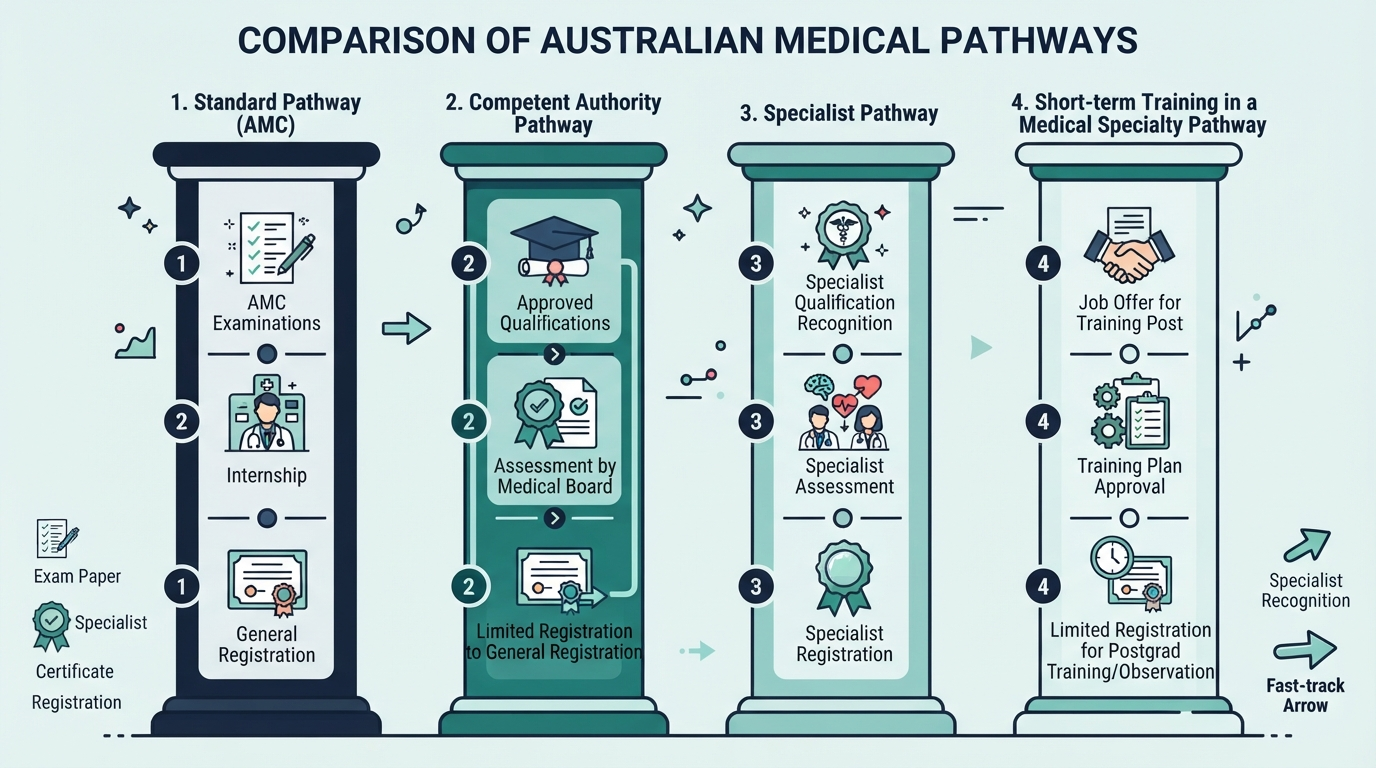
The Four Main Registration Pathways at a Glance
Before diving deep, here's a quick snapshot. Think of this as your pathway cheat sheet for AMC vs Competent Authority and beyond. We've structured it around five key columns to highlight who it's for, hurdles ahead, and real-world speed bumps.
| Pathway | Who Qualifies | Exams Required | Who Assesses | Typical Timeline | Supervision/Job Link |
|---|---|---|---|---|---|
| Standard Pathway | Most IMGs (primary medical degree holders) | AMC MCQ + Clinical | AMC | 12-24+ months | Supervised job required post-exams |
| Competent Authority | Graduates from UK, USA, Canada, NZ, Ireland (with passed exams & recent practice) | None (if eligible) | Medical Board/AHPRA | 3-12 months | Provisional + supervised position |
| Specialist Pathway | Specialist pathway Australia SIMG: Overseas-trained specialists | Varies (college workplace-based assessment) | Specialist college (e.g., RACP, RACS) | 6-24 months | Area of Need or peer-reviewed supervision |
| Expedited Specialist | Expedited specialist pathway Australia: GPs & select specialties on approved list | Streamlined college review | Approved colleges | 3-6 months (target) | Limited supervision in priority areas |
This table simplifies the Standard vs Competent Authority vs Specialist pathway Australia debate. Timelines are estimates—your mileage varies with documentation, job offers, and recency of practice. Now, let's unpack each.
1. Standard Pathway - AMC Examinations
The workhorse for most IMGs, the Standard Pathway via the Australian Medical Council (AMC) is your entry ticket if you hold a primary medical qualification not covered by faster routes. It's thorough, testing AMC MCQ (CAT computer-adaptive multiple-choice) and Clinical exams to prove intern-level competence.
Who Needs It?
- IMGs from non-competent authority countries (e.g., India, Pakistan, Egypt, most of Europe/Asia)
- Those without recent specialist training or exams from approved bodies
- Anyone aiming for general registration as a GP or non-specialist
First, verify credentials via EPIC (Electronic Portfolio of International Credentials). Pass both AMC exams? Secure a supervised position (often in rural/DPA areas), get provisional registration, complete 12 months approved training, then apply for general registration. Without it, job hunting is tough—no independent practice.
Timeline and Challenges
Expect 12-24+ months: 3-6 for MCQ prep/pass, 6-12 for Clinical (bookings can lag), plus job hunt. It's demanding but levels the field. Job search without registration? Picture endless applications in competitive markets.
2. Competent Authority Pathway
If your training hails from the UK, USA, Canada, New Zealand, or Ireland—and you've passed their licensing exams (PLAB, USMLE, MCCQE, NZREX)—this skips AMC hurdles. It's a nod to comparable standards, but not a free pass.
Eligibility Nuances
- Passed relevant exams and hold full registration there
- Recent practice (typically 1-3 years post-exam)
- EPIC verification still required
Apply to AHPRA for provisional registration, link to a supervised job (12 months minimum). Faster than Standard—often 3-12 months—but secure that position first. Great for AMC vs Competent Authority savings on exams.
It's streamlined, yet the job link keeps it real: no position, no progress.
3. Specialist Pathway - SIMG Assessment
For specialist pathway Australia SIMGs—overseas-trained in fields like cardiology, orthopedics, or psychiatry—this route assesses via the relevant Australasian college (e.g., RACP, RACS, RACGP for GPs). Outcomes: substantially comparable (specialist registration), partially (more training), or not (Standard Pathway detour).
The Process Unpacked
- College application with CV, logbooks, refs
- Peer review or workplace-based assessment
- Supervision levels 1-4 based on comparability
- Area of Need (AoN) jobs for rural/underserved spots
Timelines: 6-24 months, depending on college workload. Not instant independence—expect supervision. Ideal if you're a practicing specialist eyeing Australia.
4. Expedited Specialist Pathway
Launched late 2024, this expedited specialist pathway Australia targets shortages: GPs first, expanding to anesthesia, psychiatry, etc., on an approved list. Streamlined college assessments aim for quicker specialist recognition.
What's New and Limited
- Eligible specialties only—no broad coverage
- Fast-tracks substantially comparable cases
- Still needs job offer, limited supervision
- Target: 3-6 months processing
A game-changer for priority roles, but check the list—orthopedics might wait.
Brief Mention: Short-Term Training Pathway
Up to 24 months for observation/training visas. No path to registration—purely contextual for networking or upskilling.
Decision Factors: How to Choose Your Pathway
No one-size-fits-all. Filter via these six lenses for your Australian medical registration pathways comparison:
- Qualification Country: Competent authority list? Yes → Pathway 2.
- Specialist Status: Fellowship equivalent? Specialist or Expedited.
- Recency: 3+ years lapsed? Hurdles rise everywhere.
- Job Access: Rural/DPA willing? Opens AoN doors.
- Timeline/Budget: Exams affordable? Standard viable.
- Long-Term Goal: GP vs niche specialist dictates college.
Common Misconceptions
- UK quals = auto-skip exams: No—Competent Authority needs recent practice/job.
- Specialist = instant independence: Supervision mandatory.
- Standard = easiest: Rigorous exams, but structured.
- Expedited for all: List-bound only.
Costs and Timelines: Realistic Expectations
Fees fluctuate—check AHPRA/AMC sites. Ballpark:
- AMC exams: Thousands AUD (MCQ ~$3k, Clinical ~$3.5k)
- EPIC/AHPRA apps: $500-1k
- College assessments: $5k-15k+
Timelines: Prep, queues, jobs add variability. Budget 6-24 months realistically.
What Happens After Pathway Choice
Provisional/Limited registration → supervised practice → general/specialist. AoN for shortages (DPA rural). Progress via performance.
How IMG Navigator Helps You Make a Calmer Decision
At imgnavigatoraustralia.com, we offer independent guidance: Pathway Quiz, action lists, risk-spotting. Translate regs into steps—no overwhelm.
FAQ: Your Burning Questions
Can I apply to multiple pathways?
Yes, but prioritize one; overlaps waste fees.
If Competent Authority fails, can I go Standard?
Absolutely—AMC exams remain open.
Does expedited mean no supervision?
No—still required, though lighter.
Independent guidance only, not affiliated with AHPRA, Medical Board of Australia, AMC, or specialist colleges. Pathways and fees change. Verify with AHPRA, AMC, and relevant colleges. Information does not guarantee registration or employment.
